Audience Builder

The Audience Builder enables you to create precise audiences (or lists) of contacts and companies based on activities performed, stages reached, or properties sourced from your CRM or enriched by Dreamdata.
How can I build an Audience?
Go to Activation Hub -> Audiences -> Click "Add New Audience"
In Audiences you can group users or accounts based on events, stages, properties or signals.
Once you have created your new audience, you can save it for future use or share it with a colleague. All your saved audiences can be conveniently accessed in the Activation Hub.
How to filter your audience?
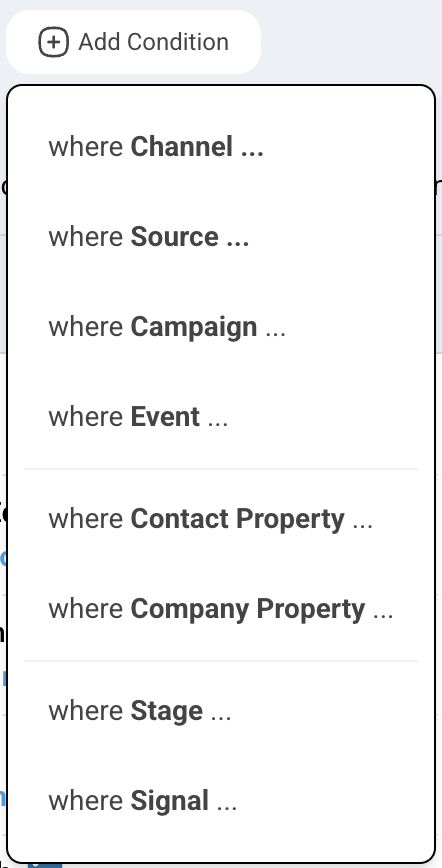
In the Contacts or Companies journey list you can click on 'Add Condition' to see all the available options and choose the types of conditions you wish to apply.
Conditions can be divided into four groups:
- Activity / Events
- Properties
- Stages
- Signal - Learn more about signals here.
Activity / Events conditions
Let's explore the activity conditions. Here, we filter based on every event received by Dreamdata, whether it's from the tracking script (analytics) or any integrated source.
These conditions are initially set using filters based on the Event, Channel, Source, or Campaign Properties. The Filter by property feature allows for additional filters if needed.
It's also important to specify the time range for the events you're considering, so that you can narrow down the data to a specific period.
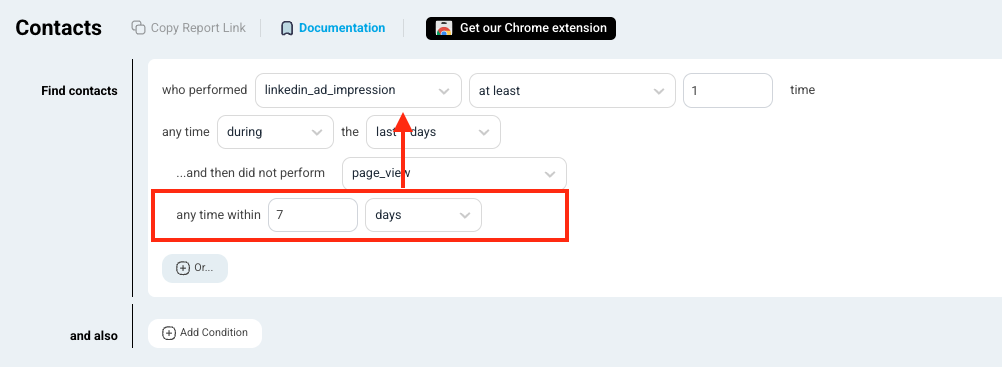
You can chain two steps together using the did perform and did not perform options.
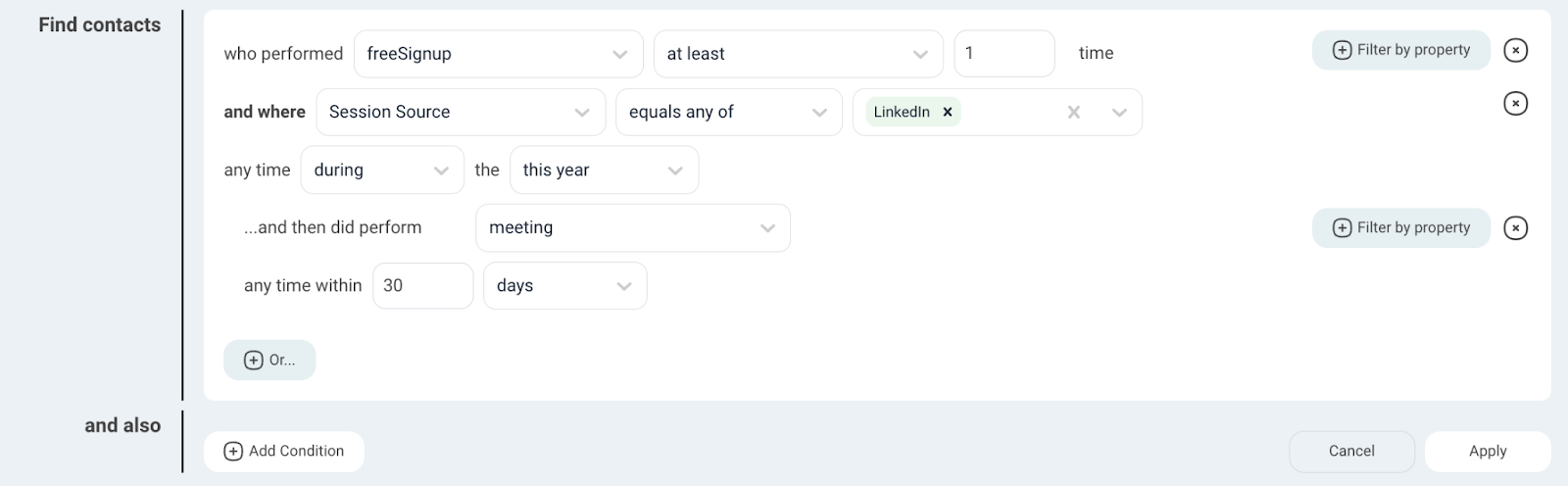
For example, the filter below will identify contacts who completed a freeSignup that came from LinkedIn this year, AND subsequently held a meeting with the sales team within 30 days of that signup event.
Properties conditions
We incorporate a property condition into the audience. This involves accessing a list of properties, encompassing both those defined by Dreamdata and those extracted from your CRM.
The filter below will apply a rule stating that all the contacts in the audience must belong to a company whose Industry property is Software & Services. This way, you will specifically target contacts from SaaS companies.

Stage Models conditions
We can utilize the stage models previously set up in Dreamdata to further refine our audience.
The filter below will apply a rule stating that all the contacts in the audience come from companies that haven't reached the NewBiz stage.

Signal conditions
A signal is a measurable event or behavior in your data that provides meaningful insights and influences your customer pipeline. You can apply conditions using these key actions.
The filter below adds a rule for which a contact must have visited the Pricing Page on our Website, at least one time within this year.

More complex queries
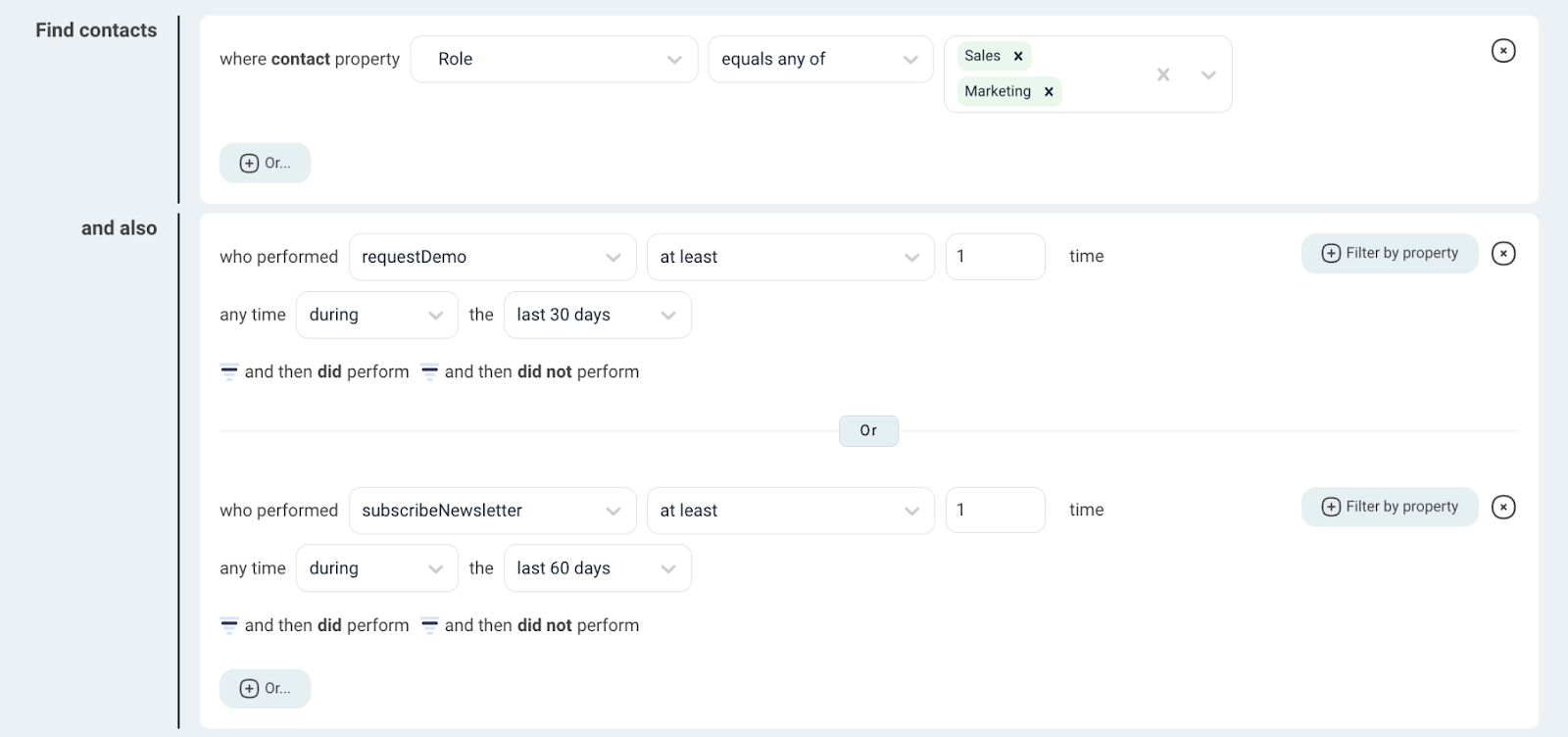
The audience builder filter in Dreamdata is equipped with the functionality to use both 'AND' and 'OR' logical operators, which adds a sophisticated level of precision and flexibility to audience segmentation.
It is possible to create complex, layered segments by intertwining 'AND' and 'OR' conditions.
With the following filter, you could target contacts with a Sales or Marketing role that requested a demo in the last 30 days OR subscribed to the newsletter in the last 60 days.
What does the Include Anonymous Companies option do?
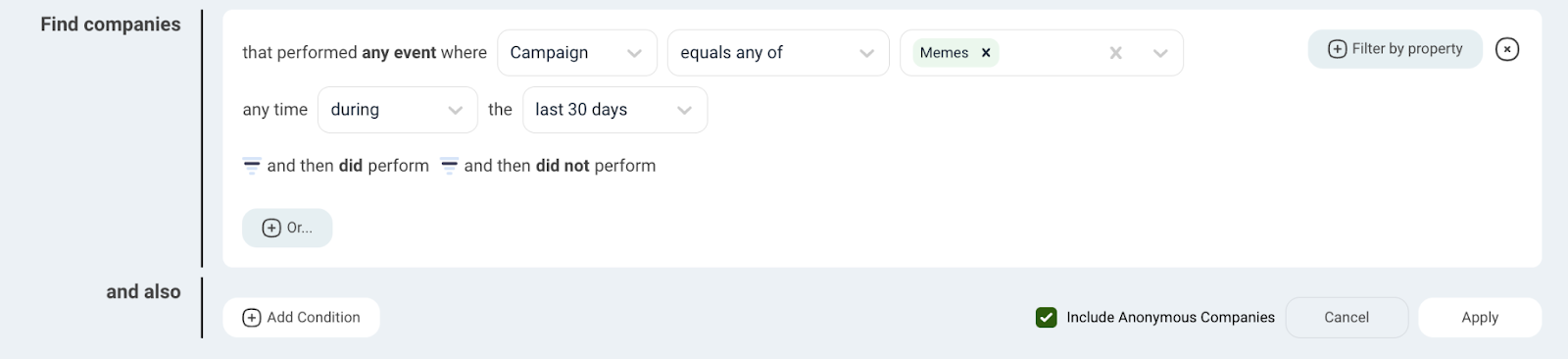
When searching for companies, you will encounter an option to include anonymous companies in your list. These are domains identified by Dreamdata through tracking (analytics), but that cannot be linked to any specific company in the CRM or associated with a business email.

The filter below will show companies that triggered an event specifically attributed to the marketing campaign "Memes", which occurred within the past 30 days.